small mindboggle logo Mindboggle
Software Data Papers People

Data

Except where noted, all data are licensed under a Creative Commons License: CC_license

Mindboggle-101: Manually labeled brain surfaces and volumes

The Mindboggle-101 dataset includes manually labeled anatomical regions for 101 healthy subjects.
The manually edited cortical labels follow sulcus landmarks according to the Desikan-Killiany-Tourville
(DKT) protocol. Please cite the following article and this website when making use of these data,
which include labeled nifti volumes (nii), vtk surfaces (vtk), and FreeSurfer files (mgh)
(see the README, the CHANGELOG, the MD5SUMS and label and original scan ID info):

“101 labeled brain images and a consistent human cortical labeling protocol”
Arno Klein, Jason Tourville. Frontiers in Brain Imaging Methods. 6:171. DOI: 10.3389/fnins.2012.00171

  • MMRR-21 brains and labels [nii, nii (MNI152), vtk, mgh]:

    All 21 subjects in the Multi-Modal MRI Reproducibility Resource MMRR www

  • NKI-RS-22 brains and labels [nii, nii (MNI152), vtk, mgh]:

    22 subjects from the Nathan Klein Institute / Rockland Sample NKI-RS www

  • NKI-TRT-20 brains and labels [nii, nii (MNI152), vtk, mgh]:

    20 subjects from the Nathan Klein Institute / Test-Retest Sample NKI-TRT www

  • OASIS-TRT-20 brains and labels [nii, nii (MNI152), vtk, mgh]:

    All 20 subjects from the OASIS Test-Retest sample OASIS-TRT www

  • OASIS-TRT-20 subcortex [nii] by Neuromorphometrics CC_license_nond:

    These 20 volumes were also labeled according to the BrainCOLOR protocol

  • Extra-18 brains and labels [nii, nii (MNI152), vtk, mgh]:
    • HLN-12: All 12 subjects from the Human Language Network study

    • MMRR-3T7T-2: 2 subjects acquired like MMRR-21
    • Colin27-1: Colin Holmes template (average of 27 scans)

    • Twins-2: 2 identical twins, including AK

    • Afterthought-1: 1 brain imager, SG

  • fsaverage [nii and mgh DKT-labeled fsaverage]:

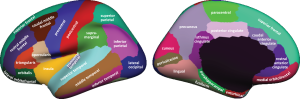
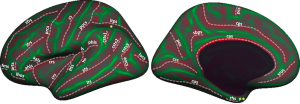
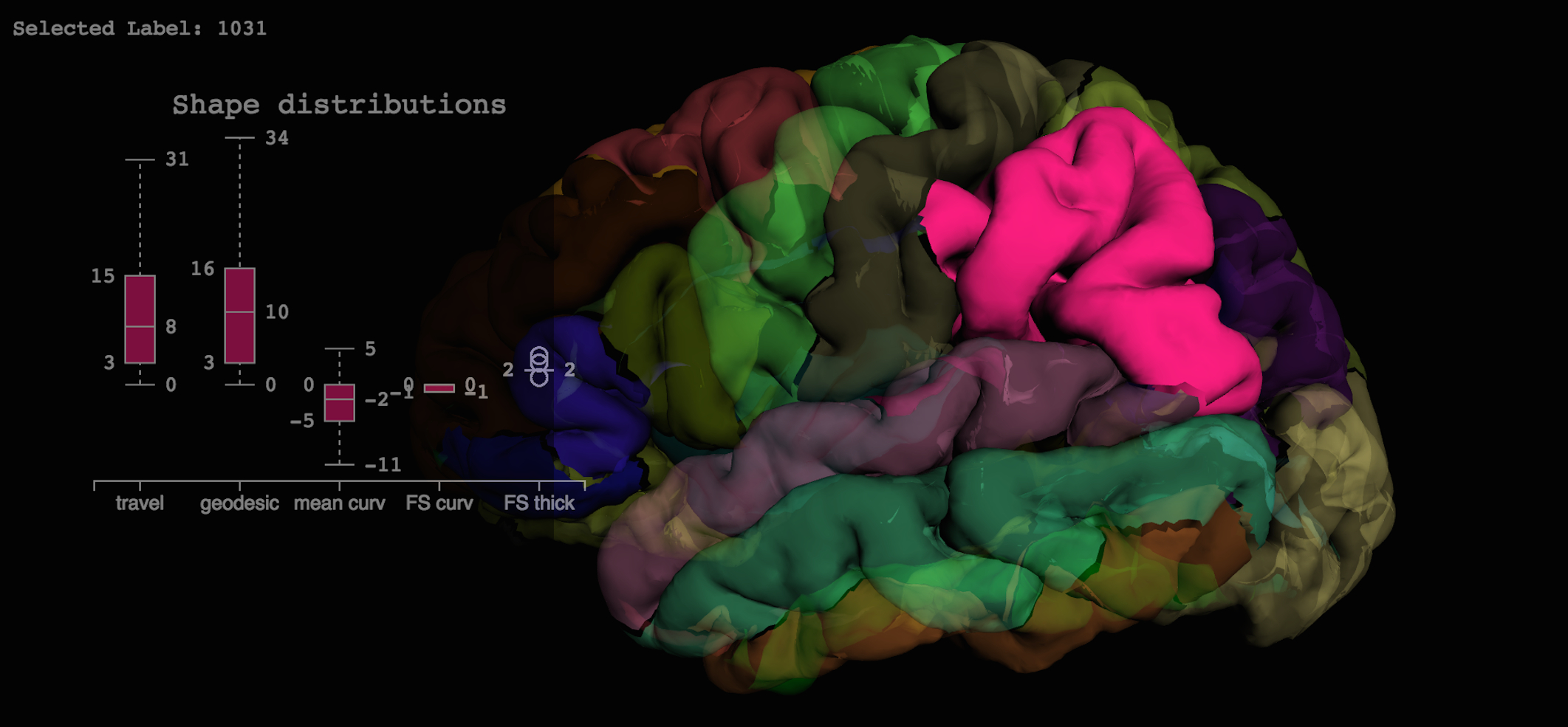
    The figures below show the DKT cortical labeling protocol on FreeSurfer’s fsaverage surface:


http://media.mindboggle.info/images/data/DKT_labels_width800px.png


http://media.mindboggle.info/images/data/DKT_sulci_width800px.png

Mindboggle-101 atlases

Each of the 101 individually labeled brain surfaces and volumes above is an atlas,
a labeled or annotated brain image used for transferring labels to unlabeled brains.
We have combined their labels to create aggregate atlases here as well.
The purpose of registering to atlases is to help give a rough anatomical labeling,
or to initialize labels for further refinement, as is done by the Mindboggle software.

Mindboggle-101 templates

A template is an unlabeled image used as a reference or standard, often for registering other images to each other.
Each one of the image volumes and surfaces below was constructed by combining the images from multiple subjects.
ANTS templates were made with buildtemplateparallel.sh and FreeSurfer templates with make_freesurfer_template.py.

Brain volumes: ANTS nonlinear optimal average templates (.nii.gz)

Head volumes: ANTS nonlinear optimal average templates (.nii.gz)

Cortical surfaces: FreeSurfer nonlinear optimal average templates (.tif)

Other templates and manually labeled brains

The Mindboggle-101 templates and manually labeled brains above benefit from the application
of a consistent labeling protocol by the same labelers, to reduce variability in label assignments.
The following manually labeled image volumes used different labeling protocols,
but have been evaluated for use with registration-based labeling and brain extraction
(see 2009 evaluation and Atropos articles), as have the templates.

Atlases: manually labeled volumes (.nii.gz)

  • CUMC-12: 12 labeled brains
  • IBSR-18: 18 labeled brains
  • MGH-10: 10 labeled brains
  • Atropos-18: 8-class labeled templates for brain extraction, from 18 subjects

Templates: ANTS nonlinear optimal average templates (.nii.gz)


http://media.mindboggle.info/images/data/evaluation2009_80atlases.png